

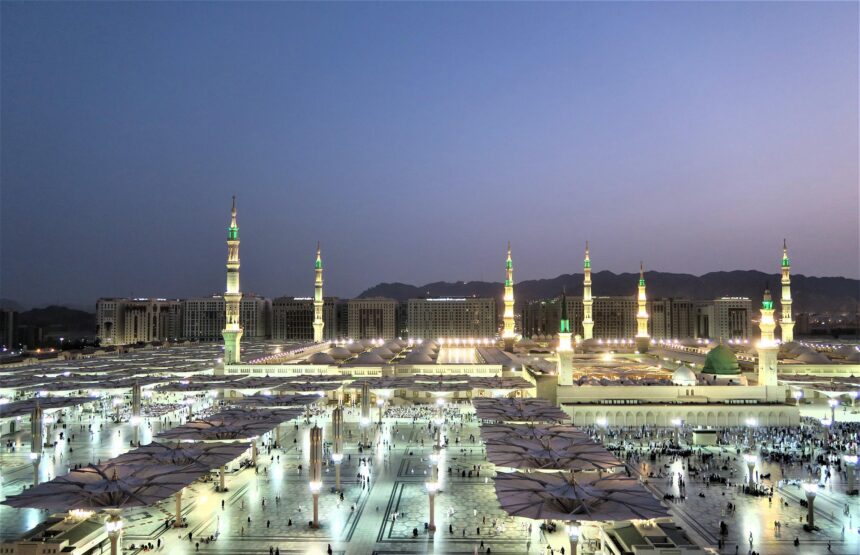
The Saudi-led coalition fighting Yemen’s Houthis has accused the Iran-aligned group of carrying out a drone attack on an electricity distribution facility in the holy city of Medina, raising tensions around Saudi Arabia’s two holiest Islamic cities as fighting between the Houthis and Saudi-backed Yemeni government forces intensifies across several fronts in Yemen. According to the coalition, the attack took place on Tuesday, September 29, at a power distribution station in Medina that supplies electricity to the Prophet’s Mosque, or Masjid an-Nabawi. The coalition said the strike put one transformer out of service but did not disrupt the wider electricity network or interrupt the overall power supply. Saudi military authorities said an investigation, including an examination of debris recovered from the drone, led them to conclude that the Houthis were involved in planning and carrying out the attack. The Houthis have rejected the accusation. A Houthi military source quoted by the group’s Saba news agency described the Saudi claim as false and said it was intended to divert attention from Saudi Arabia’s earlier accusation that the Houthis had attempted to target the holy city of Mecca. The Saudi-led coalition said the Medina incident was part of what it described as a continuing series of Houthi attempts to target the Two Holy Mosques, Masjid al-Haram in Mecca and Masjid an-Nabawi in Medina. Coalition officials said such alleged attacks could be aimed at provoking Muslims around the world and emphasized that Saudi authorities would continue measures intended to protect the holy sites as well as pilgrims and visitors in Mecca and Medina. The allegations come amid a broader deterioration in relations between Saudi Arabia and the Houthis, with cross-border attacks and military operations intensifying after a period in which a United Nations-brokered truce had largely reduced direct hostilities. On Thursday, the Saudi-led coalition also said its forces had intercepted and destroyed four drones launched by the Houthis over the southern Saudi city of Khamis Mushait. The coalition further reported that two ballistic missiles were intercepted and destroyed over Khamis Mushait and the southern city of Jazan. These claims were presented by Saudi authorities as part of a continuing effort to defend Saudi territory against Houthi missile and drone attacks. The latest developments in Saudi Arabia coincided with renewed and intense fighting inside Yemen, particularly in Taiz province in the southwest of the country. Saudi-backed forces supporting Yemen’s internationally recognized government said they had repelled a large-scale Houthi assault and inflicted heavy losses on Houthi fighters. According to the Yemeni government forces, fighting took place across several fronts, including Jabal Habashi and Maqbanah districts west of Taiz and the al-Aqrud front in al-Masrakh district to the southeast. The forces claimed that at least 30 Houthi fighters were killed on the al-Aqrud front alone and that dozens more were wounded. They also reported six airstrikes that they said caused heavy losses on fronts southeast of Taiz and in the Humayr area of Maqbanah. These battlefield casualty figures were claims by the Saudi-backed government forces and could not be independently verified. The renewed fighting is also adding to Yemen’s already severe displacement crisis. According to figures cited by Al Jazeera from Yemen’s internally displaced persons camp management unit, 197,906 people, representing 29,519 families, had been officially registered as internally displaced as of Wednesday. More than 97,000 displaced people were reported to be staying in Taiz province, while more than 50,000 were in neighboring Lahij. The continuing battles around Taiz therefore carry consequences beyond the immediate military confrontation, particularly for civilians who have already been forced from their homes by years of conflict. Saudi Arabia has also increased its financial support for Yemen’s internationally recognized government as the fighting continues. On Thursday, Riyadh announced 224 million Saudi riyals, equivalent to about $59.7 million, in budget funding for the Yemeni government. Saudi Ambassador to Yemen Mohammed al-Jabir said the funding was intended to support government financial flows, improve fiscal policy and contribute to the purchasing power of Yemeni citizens. The financial assistance comes as Saudi Arabia continues to back the Yemeni government politically, financially and militarily in its confrontation with the Houthis. The escalation is also unfolding against the backdrop of strategic changes along Yemen’s Red Sea coast. According to Al Jazeera, Houthi forces expanded their control over the strategically important Bab al-Mandeb area after taking the Red Sea city of Mocha last month. Bab al-Mandeb, which links the Red Sea with the Gulf of Aden, is one of the world’s most important maritime passages, connecting shipping routes between the Indian Ocean and the Mediterranean through the Suez Canal. Any prolonged military escalation around the waterway could therefore have implications beyond Yemen and Saudi Arabia, particularly for commercial shipping, energy supplies and regional security. The dispute over the Medina power facility also comes after Saudi Arabia previously accused the Houthis of attempting to target Mecca, an allegation the group denied. Saudi authorities said they had intercepted and destroyed a Houthi drone south of Mecca before it entered restricted airspace over the city. The Houthis rejected the accusation and denied targeting Mecca or any other Islamic holy site. The competing accounts have added another sensitive dimension to the already escalating conflict, because any confirmed attack affecting the holy cities of Mecca or Medina would carry consequences far beyond the immediate military arena. The Saudi-led coalition has stressed that protecting the Two Holy Mosques and ensuring the safety of pilgrims and visitors remain priorities amid the latest security developments. At the same time, the Houthis continue to deny accusations that they have deliberately targeted Islamic holy sites. The conflicting claims surrounding the Medina incident therefore remain a central point of dispute between the two sides, while military operations continue both inside Yemen and around Saudi territory. The latest escalation illustrates how the Yemen conflict is once again developing into a wider regional security concern, linking battlefield fighting in Taiz with drone and missile attacks involving Saudi Arabia and growing tensions around the Red Sea. For civilians in Yemen, particularly those displaced by the fighting, the renewed confrontation threatens to deepen an already serious humanitarian crisis. For Saudi Arabia, the reported attacks have increased security concerns around critical infrastructure and the country’s southern regions, while the reported Medina incident has placed particular attention on the protection of facilities serving one of Islam’s most important holy sites. As both sides continue to issue competing accounts of military operations and responsibility for attacks, independent verification of individual battlefield claims remains difficult. The situation is therefore being closely watched for signs of further escalation, particularly around Taiz, Saudi Arabia’s southern cities and the strategically important Red Sea corridor.
Source: Al Jazeera