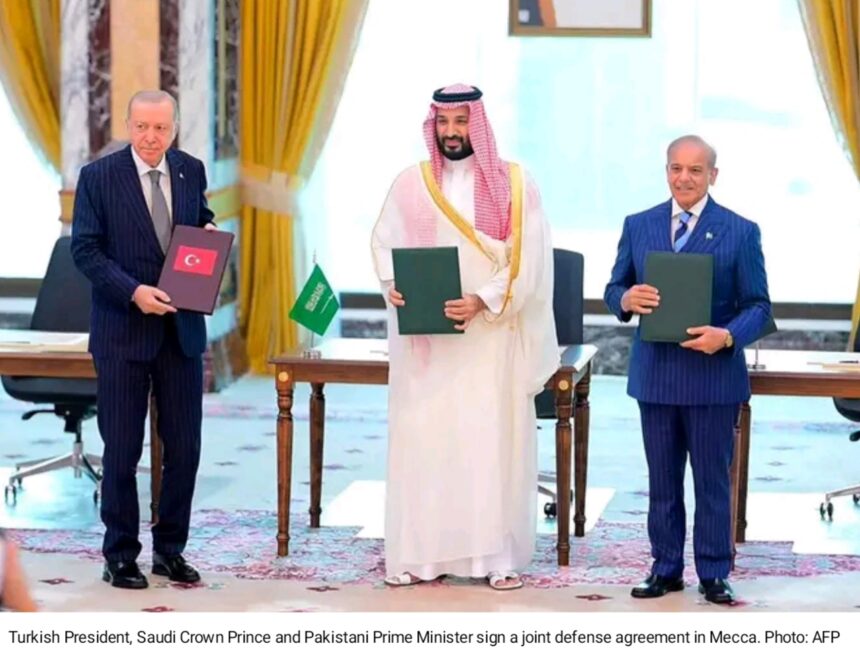
Mecca , Saudi Arabia — Saudi Arabia, Türkiye and Pakistan have signed a landmark trilateral defence agreement in Mecca, creating a new security partnership that could reshape the strategic balance across the Middle East at a time of intensifying regional conflict, uncertainty over the future role of the United States and growing concerns about the reliability of traditional security arrangements. The agreement, signed on Friday by Saudi Crown Prince Mohammed bin Salman, Turkish President Recep Tayyip Erdoğan and Pakistani Prime Minister Shehbaz Sharif, commits the three countries to treating an armed attack against one member as an attack against all, although analysts caution that the precise circumstances under which the pact would require military intervention remain unclear. The agreement builds on a defence arrangement concluded between Saudi Arabia and nuclear-armed Pakistan last year and represents the most significant step yet towards a broader security relationship linking three influential Muslim-majority states with very different military and economic capabilities. Mohammed bin Salman, Recep Tayyip Erdoğan and Shehbaz Sharif have presented the agreement as a measure designed to strengthen deterrence and protect their national security rather than as an alliance directed against a particular country. Yet its emergence comes amid a profound transformation in the region, where the prolonged confrontation involving Iran, Israel and the United States, continuing instability in Yemen, tensions around vital maritime routes and doubts about Washington’s long-term security commitments have encouraged regional powers to reconsider their strategic options.
The pact, known as the Mecca Joint Defence Agreement, could eventually become the foundation of a wider regional security framework, but analysts say it is too early to determine whether it will develop into a formal military bloc. The distinction is important because the language surrounding collective defence leaves room for political interpretation. An attack on one member being considered an attack on all does not necessarily mean that the other two governments would automatically deploy troops or enter a war. Instead, each crisis would likely be assessed according to its circumstances, the scale of the attack and the political interests of the three governments. That ambiguity could allow Saudi Arabia, Türkiye and Pakistan to demonstrate unity while avoiding an automatic commitment to conflicts that may originate far beyond their immediate national interests.
The security challenges facing the three countries are nevertheless substantial. Pakistan has faced prolonged security tensions along its western frontier and has a long history of confrontation with India, another nuclear-armed state. Saudi Arabia has repeatedly faced attacks involving Iran and Iranian-aligned armed groups, while Türkiye has spent decades confronting Kurdish armed organisations and has become increasingly involved in the wider security calculations surrounding Syria, Iraq and the eastern Mediterranean. Relations between Türkiye and Israel have also deteriorated sharply as Ankara has taken an increasingly critical position towards Israeli military operations in the region. These separate security pressures provide a powerful incentive for the three governments to coordinate their defence capabilities, intelligence, military industries and diplomatic positions.
The strategic value of the partnership lies partly in the complementary strengths of its members. Pakistan possesses one of the world’s most experienced conventional militaries among Muslim-majority countries and maintains a nuclear arsenal, giving the alliance a significant strategic dimension. Türkiye brings a sophisticated defence-industrial base, advanced drone technology, naval and aerospace capabilities and its position as a major NATO member. Saudi Arabia, meanwhile, has enormous financial resources and has invested heavily in modernising its armed forces, air defence systems and military infrastructure. Together, the three countries can potentially combine military manpower, defence manufacturing, strategic deterrence, technological capabilities and financial resources in ways that none of them could easily replicate alone.
The pact also reflects a broader question confronting Middle Eastern governments: how much can they continue to rely on the United States for their security? For decades, Washington has been the principal external security partner for Saudi Arabia and an important strategic partner for Türkiye, despite periods of serious disagreement. But repeated regional crises and shifts in US foreign policy have encouraged governments across the Middle East to seek greater strategic autonomy. Saudi Arabia in particular has expanded relations with China, Russia, Türkiye and other powers while attempting to maintain its longstanding relationship with Washington. The Mecca agreement can therefore be viewed not simply as a military arrangement but also as part of a wider effort by regional powers to diversify their strategic partnerships.
The development comes against the backdrop of a Middle East already divided by competing security structures. Israel has built a network of diplomatic and security relationships with several Arab states through the US-backed Abraham Accords, while Iran maintains relationships with a range of armed and political groups across the region. The emergence of a Saudi-Turkish-Pakistani security partnership introduces another potential centre of influence. Some analysts have described this as the possible beginning of a third regional axis, positioned between the Israeli-aligned security framework and Iran’s network of partners. But such descriptions remain speculative, because the three signatories have significant differences in their foreign policies and economic priorities.
The relationship between Saudi Arabia and Türkiye illustrates how rapidly regional alignments can change. The killing of Saudi journalist Jamal Khashoggi at the Saudi consulate in Istanbul in 2018 produced a severe diplomatic rupture between Riyadh and Ankara. Yet both governments gradually moved towards reconciliation as their strategic priorities changed. By the early 2020s, economic interests, regional diplomacy and a shared desire to reduce tensions had brought the two countries closer. Pakistan, meanwhile, has maintained deep historical and military ties with Saudi Arabia while balancing its relations with other major powers. The new agreement brings these separate relationships into a more formal security framework.
Whether the pact will expand is now one of the most closely watched questions. Egypt, Qatar, Syria and the United Arab Emirates could potentially become important partners in any broader regional security structure, but each faces different political and strategic constraints. Egypt has traditionally been cautious about military commitments that could pull it into wider regional conflicts and has prioritised economic stability. Qatar maintains its own diplomatic strategy and has historically sought to preserve channels with multiple regional powers. Syria remains focused on reconstruction after years of devastating conflict, while its proximity to Israel makes any new military alliance particularly sensitive. The United Arab Emirates has strong relations with Saudi Arabia but has also pursued policies that have sometimes diverged from Riyadh and Ankara, particularly over Yemen and its relationship with Israel.
The possibility of expansion therefore remains uncertain. A larger alliance could create greater military and economic weight, but it could also expose the members to competing interests and difficult strategic commitments. The experience of previous regional coalitions demonstrates that political unity can be easier to announce than to maintain when members face different threats and priorities.
The Yemen conflict presents an immediate test of the agreement. If Houthi forces were to launch a major attack against Saudi territory or critical infrastructure, questions would quickly arise over whether Türkiye and Pakistan would consider such an incident grounds for collective military action. Similarly, any escalation involving Iran, Israel or another regional actor could test the limits of the pact. The three governments have therefore avoided presenting the agreement as a mechanism for automatic participation in every conflict involving one of its members.
For Saudi Arabia, the pact offers an additional layer of security at a moment when the kingdom is attempting to protect its economic transformation and major infrastructure projects from regional instability. For Türkiye, it provides another avenue to expand its strategic influence across the Gulf and strengthen defence cooperation with a wealthy partner. For Pakistan, the agreement could deepen its longstanding relationship with Saudi Arabia while opening new opportunities for defence cooperation with Türkiye, whose military industry has become increasingly important in international markets.
The agreement also has an important symbolic dimension. The choice of Mecca as the location for the signing gives the pact religious and political significance, while bringing together three of the most influential Muslim-majority states in a period of intense regional uncertainty. Yet symbolism alone cannot determine the future of the alliance. Its credibility will ultimately depend on whether the three governments are prepared to accept significant political, economic and military risks on behalf of one another.
The Middle East has witnessed numerous alliances and strategic partnerships over the past several decades, many of which have changed as governments reassessed their interests. The Mecca pact could follow the same pattern, or it could become the foundation of a more durable regional security architecture. Much will depend on how the three countries respond to the next major crisis.
For now, the agreement sends a clear political message: Saudi Arabia, Türkiye and Pakistan are seeking greater control over their own security at a time when the regional balance is rapidly changing. Whether that message develops into a permanent military alliance, a flexible strategic partnership or simply a temporary alignment remains uncertain. But the decision by three major powers to formally link their security interests marks a significant development in the Middle East’s evolving geopolitical landscape.
The real test will come not at the signing ceremony in Mecca but during the next serious crisis. If one of the three countries comes under sustained military attack, the world will discover whether the phrase “an attack on one is an attack on all” represents a binding commitment or a powerful statement of deterrence. Until then, the Mecca Joint Defence Agreement stands as an important sign that the region’s traditional security order is changing—and that Middle Eastern powers are increasingly looking to build strategic arrangements of their own.
Mecca Agreement in the Shadow of Iran-Israel Conflict, Three Countries on the Path to a New Military Alliance