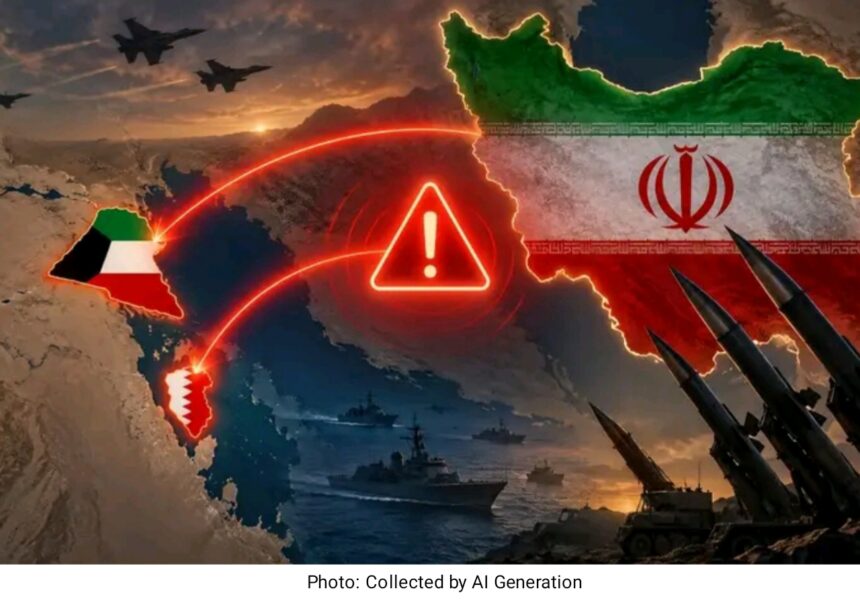
Iran’s Islamic Revolutionary Guard Corps Navy has issued an urgent warning to crews aboard oil tankers operating near ports and anchorages in Kuwait and Bahrain, ordering them to leave their vessels immediately and warning that ships remaining at berth or at anchor could be targeted, in a significant escalation of the widening confrontation between Iran and the United States across the Gulf. The warning, carried by Iranian state-linked media, came after U.S. forces destroyed five Iranian-linked oil tankers, according to U.S. Central Command, following Iranian ballistic-missile attacks against a U.S. Navy warship. The IRGC said its warning was issued in response to what Tehran described as hostile U.S. military actions against Iranian oil tankers and specifically singled out Kuwait and Bahrain because both Gulf states host U.S. military facilities. The latest threat has raised fresh concerns over the safety of commercial shipping in the region, particularly as the conflict increasingly extends beyond the immediate waters of the Strait of Hormuz and places civilian maritime traffic at greater risk. U.S. Central Command said the five tankers were targeted after their crews had been warned to abandon the vessels, while Iranian state-affiliated reports said at least some of the strikes occurred near Jask and Kharg Island, areas closely connected to Iran’s oil-export infrastructure. In response, Iranian authorities have warned that further attacks on Iranian maritime assets could trigger retaliation against U.S. military positions across the region. The developments come as shipping activity through the Strait of Hormuz has fallen sharply amid growing fears among shipowners, crews and energy traders that commercial vessels could become caught in the conflict. Preliminary shipping data cited by Reuters showed that only six commodity vessels passed through the strategic waterway on Tuesday, compared with a 10-day average of about 12, while traffic before the current conflict was dramatically higher. The Strait of Hormuz remains one of the world’s most important energy chokepoints, carrying a substantial share of global crude oil and liquefied natural gas shipments, meaning prolonged disruption could have consequences far beyond the Middle East. Oil prices have already risen above $100 a barrel as markets react to the deteriorating security situation, with traders increasingly concerned that continued attacks on tankers could restrict regional supplies and further disrupt global energy markets. The Iranian warning also comes at a time when the broader regional conflict is expanding on several fronts, with Iran-linked forces and U.S. military assets increasingly involved in retaliatory attacks across the Middle East. Tehran has accused Washington of escalating the conflict through attacks on Iranian vessels, while the United States has said its military actions followed repeated Iranian attacks against U.S. forces and shipping. The competing claims underline the rapidly deteriorating security environment surrounding the Gulf, where commercial tankers, ports and maritime infrastructure could increasingly become exposed to military operations. Kuwait and Bahrain have not themselves been identified as direct participants in the attacks on Iranian tankers, but their hosting of U.S. military facilities has placed them at the center of Tehran’s latest warning. The threat does not necessarily mean an attack on commercial vessels will take place, and any reports of subsequent strikes, casualties or damage would require independent confirmation. Nevertheless, the warning represents a serious new risk for international shipping and raises the possibility that the Iran-U.S. confrontation could increasingly affect commercial vessels inside Gulf ports rather than remaining concentrated around the Strait of Hormuz. With maritime traffic already declining, oil prices rising and military threats spreading across the region, governments, shipping companies and energy markets are closely monitoring the situation for signs of further escalation. Any sustained disruption to tanker movements through the Gulf could place additional pressure on global energy supplies, increase transportation and insurance costs and intensify economic uncertainty at a time when international markets are already reacting to the widening conflict. The situation remains highly fluid, and further developments could determine whether the latest Iranian warning remains a deterrent message or becomes the prelude to direct attacks against commercial shipping in the Gulf.
Iran Warns Tanker Crews in Kuwait and Bahrain to Leave Vessels as Gulf Maritime Tensions Escalate