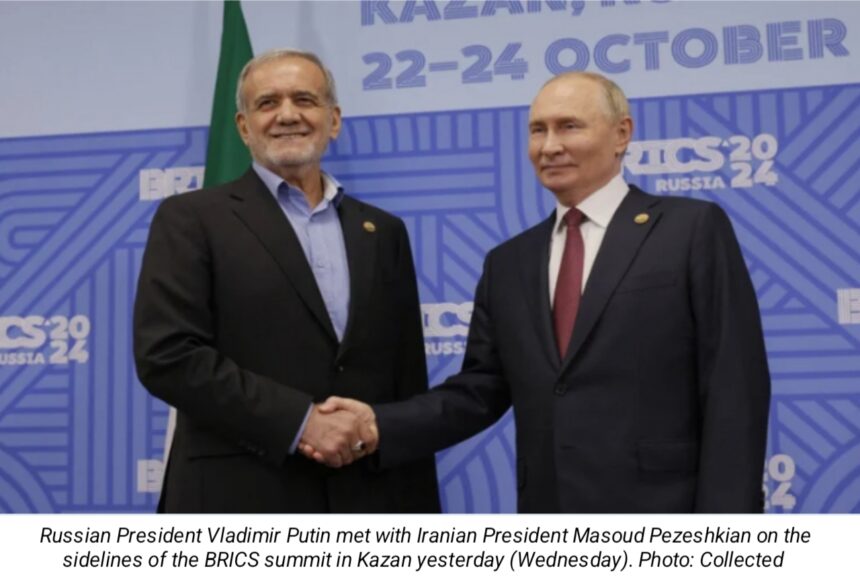
Speculation surrounding Russia–Iran military cooperation has intensified across the international arena, placing renewed focus on the evolving strategic partnership between Moscow and Tehran and its potential implications for regional and global security. Although the official agenda of the meeting between U.S. Secretary of State Marco Rubio and Russian Foreign Minister Sergey Lavrov on the sidelines of the ASEAN Foreign Ministers’ Meeting in Manila centered on the war in Ukraine, diplomatic engagement, and broader international security issues, another highly sensitive subject has increasingly attracted the attention of Western governments and intelligence agencies: whether Russia may have secretly provided intelligence, satellite surveillance, or technological assistance to Iran during its recent missile and drone attacks against U.S. military and intelligence-related facilities in the Middle East. A growing number of international media reports, intelligence assessments, and security analyses have elevated this question from speculation to a matter of strategic concern, even though no independent or conclusive public evidence has yet been presented to confirm such allegations.
According to reports published by several major international news organizations, including The Washington Post, CNN, and Reuters, U.S. intelligence officials have been examining the remarkable precision of recent Iranian drone and missile strikes, particularly those targeting sensitive American installations and strategic infrastructure. Following attacks reportedly directed at facilities linked to U.S. intelligence operations in Saudi Arabia and other regional locations, some Western intelligence officials reportedly began investigating whether Iran had access to advanced targeting information beyond its own surveillance capabilities. Analysts note that the accuracy of certain strikes, combined with their apparent synchronization and operational planning, has prompted questions about whether external intelligence support may have contributed to the effectiveness of these operations. Nevertheless, Western governments have not publicly released definitive evidence linking Russia directly to the attacks, and officials continue to describe the investigation as ongoing.
Security experts argue that the military relationship between Russia and Iran has evolved significantly since the outbreak of the Ukraine war, expanding well beyond conventional arms cooperation into broader areas including intelligence sharing, electronic warfare, satellite-based reconnaissance, cyber capabilities, navigation technologies, and advanced defense research. Nicole Grajewski, Assistant Professor at the Center for International Studies at Sciences Po in Paris, has suggested that while Iran has substantially improved its domestic military-industrial capabilities, Russia maintains far more sophisticated satellite surveillance and space-based intelligence assets. According to her assessment, if intelligence cooperation exists between Moscow and Tehran, it could significantly improve Iran’s ability to identify, monitor, and accurately strike high-value targets. At the same time, she emphasizes that Iran possesses one of the region’s most extensive human intelligence networks, developed over decades through regional partnerships and allied organizations, meaning that not every successful operation necessarily requires foreign intelligence support.
Since Russia launched its full-scale invasion of Ukraine, relations between Moscow and Tehran have entered what many analysts describe as a new strategic phase. Facing extensive Western sanctions and diplomatic isolation, both countries have steadily expanded cooperation across military, economic, technological, and political sectors. Western governments have repeatedly accused Iran of supplying Russia with Shahed-series drones and ballistic missile technology that has allegedly been used in Ukraine. In return, multiple international reports have claimed that Russia has assisted Iran in improving drone production, electronic warfare systems, anti-jamming navigation technologies, air defense modernization, and advanced military training. Particular attention has focused on allegations that Russian Kometa-M anti-jamming navigation systems have been incorporated into Iranian-made Shahed-136 drones, increasing their resilience against electronic interference. Moscow has consistently rejected these accusations, describing them as politically motivated disinformation intended to undermine Russia’s international standing.
Analysts also point to the comprehensive 20-year strategic partnership agreement signed between Russia and Iran in 2025 as a milestone that institutionalized bilateral cooperation across defense, technology, energy, trade, infrastructure, banking, transportation, and scientific development. Although Russian officials have repeatedly stressed that the agreement does not constitute a formal military alliance comparable to NATO and creates no automatic mutual defense obligations, many experts argue that it nevertheless reflects a long-term strategic convergence driven by shared geopolitical interests and common opposition to Western pressure. The agreement has accelerated efforts to expand trade in national currencies, strengthen the International North–South Transport Corridor, deepen defense-industrial cooperation, and reduce dependence on Western financial systems.
Meanwhile, escalating military confrontation between the United States and Iran has dramatically increased tensions throughout the Middle East. U.S. forces have continued conducting strikes against Iranian military infrastructure, missile facilities, and strategic assets, while Iran has responded through drone and missile operations targeting American interests and allied positions across the Gulf region. The exchange of military actions has heightened concerns over the security of maritime shipping lanes, the stability of global energy supplies, the safety of the Strait of Hormuz, and the broader resilience of international trade networks. Every escalation has generated fresh uncertainty in global financial markets, contributing to fluctuations in oil prices, increased insurance costs for commercial shipping, and renewed fears of wider regional conflict.
Some Western strategic analysts believe the expanding Middle East crisis may also provide indirect geopolitical advantages to Russia. As Washington devotes greater military resources, diplomatic attention, and political capital to managing simultaneous crises in the Middle East, international focus on the war in Ukraine could diminish, potentially easing some strategic pressure on Moscow. A prolonged regional conflict could also complicate Western defense planning by stretching military resources across multiple theaters simultaneously. Others, however, caution that sustained instability in the Middle East carries significant risks for Russia as well, particularly given Moscow’s own strategic interests throughout the region and its relationships with numerous regional actors.
Military experts further emphasize that Iran’s growing defense capabilities are fundamentally rooted in decades of domestic investment in indigenous missile programs, drone development, asymmetric warfare doctrine, and extensive regional partnerships. Even if Russia has provided intelligence or technological assistance, many analysts argue such support would likely enhance the effectiveness and precision of existing Iranian capabilities rather than create entirely new military capacities. Consequently, while speculation regarding intelligence cooperation continues, experts urge caution against drawing definitive conclusions before independently verified evidence becomes available.
The Rubio–Lavrov meeting in Manila has therefore come to symbolize far more than diplomatic discussions concerning Ukraine. It reflects a broader strategic competition involving Russia, Iran, the United States, and the wider international community, highlighting the increasingly interconnected nature of European and Middle Eastern security. Diplomatic observers suggest that future developments in the Russia–Iran partnership could significantly influence U.S. foreign policy, NATO strategic planning, regional security architecture, international sanctions policy, and the global balance of power. Intelligence investigations currently underway in several Western countries are expected to remain central to this evolving debate.
Despite the growing volume of allegations, analysts consistently stress that no independent international investigation or publicly available conclusive evidence has yet confirmed direct Russian involvement in supporting Iran’s recent military operations against U.S. facilities. As a result, many of the current claims remain matters of investigation, intelligence assessment, and informed analysis rather than established fact. Nevertheless, the expanding strategic partnership between Moscow and Tehran has already become one of the defining geopolitical developments of the current international landscape. Whether future intelligence disclosures substantiate or refute the allegations of covert cooperation, the trajectory of Russia–Iran relations will almost certainly continue shaping security dynamics across the Middle East, influencing great-power competition, and redefining the global strategic balance for years to come.
New chapter in Moscow-Tehran partnership, changing global balance of power