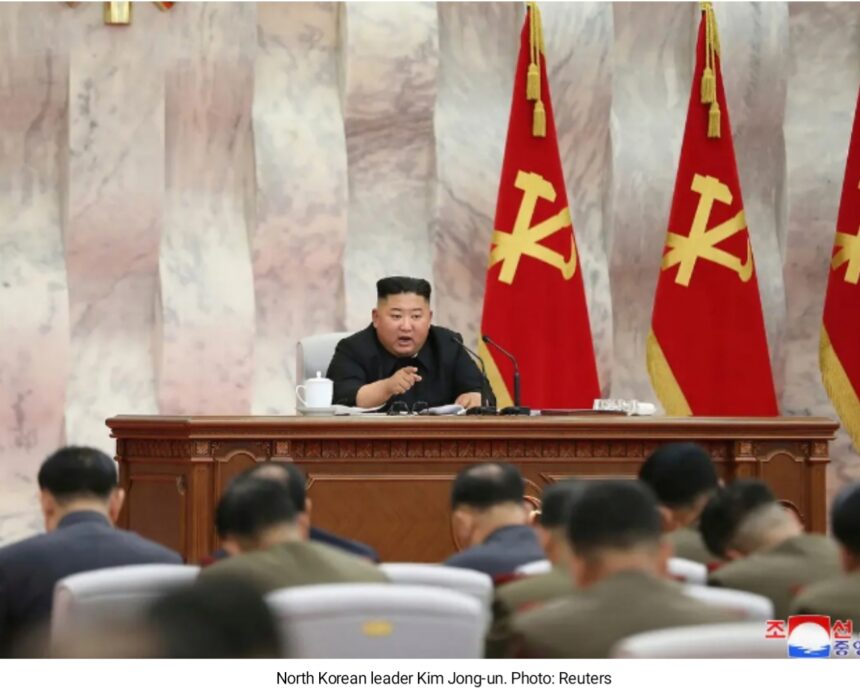
North Korea’s latest ballistic missile launches have renewed international concern over the rapid evolution of Pyongyang’s nuclear and missile capabilities, coming just hours after U.S. President Donald Trump signalled that he expected to meet North Korean leader Kim Jong Un later this year. The launches, which involved a barrage of short-range ballistic missiles fired toward the East Sea on August 20, have added a new layer of strategic uncertainty to Washington’s efforts to reopen direct diplomacy with Pyongyang. The timing was particularly significant because South Korea simultaneously disclosed a much higher assessment of North Korea’s nuclear stockpile, with Defence Minister Ahn Gyu-back telling lawmakers that Pyongyang may possess between 80 and 120 nuclear warheads, based on assessments by private research organisations. Seoul stressed that the figure cannot be independently verified, underscoring the longstanding difficulty of determining the precise scale of North Korea’s nuclear arsenal. The estimate nevertheless represents a substantial increase over the figure of 57 nuclear weapons recently cited publicly by Trump and highlights the wide gap between different assessments of Pyongyang’s capabilities. For Washington, the uncertainty is strategically important because the size of North Korea’s nuclear force directly affects the scope and complexity of any future arms-control or denuclearisation negotiations. North Korea has spent years expanding its nuclear programme, missile forces and weapons infrastructure while resisting demands for unilateral denuclearisation. Pyongyang has also remained deeply sceptical of U.S. and South Korean diplomatic initiatives, despite indications that the personal relationship between Trump and Kim remains less hostile than the broader political relationship between the two countries. North Korea’s reaction to Washington’s decision to reduce the scale of joint U.S.-South Korean military exercises further demonstrated the difficulty of changing the security dynamics on the Korean Peninsula. Pyongyang dismissed the adjustment as insufficient to alter its fundamental assessment of the exercises, which it has long portrayed as a rehearsal for invasion. At the same time, Kim Yo Jong acknowledged that relations between Trump and Kim retain a degree of personal positivity, leaving open a narrow channel for renewed leader-level diplomacy. The developments present Washington with a difficult strategic calculation. Trump appears interested in restoring the direct engagement that produced historic summits with Kim in 2018 and 2019, but North Korea could enter any new negotiations with a substantially larger nuclear capability than it possessed during those earlier encounters. The central question for U.S. policymakers may therefore no longer be whether North Korea can be persuaded to abandon an emerging nuclear capability, but how negotiations could manage, limit or eventually reduce an arsenal that may already be considerably larger than previously estimated. Any future Trump-Kim meeting would consequently take place under markedly different circumstances from the earlier summits, when Washington placed complete denuclearisation at the centre of its diplomatic strategy. Today, Pyongyang’s expanding nuclear and missile capabilities could give Kim greater leverage at the negotiating table, while Washington and its regional allies would face increased pressure to strengthen deterrence without closing the door to diplomacy. South Korea, meanwhile, must balance support for dialogue with growing concerns about the potential scale of its neighbour’s nuclear force. Japan also remains closely watching developments because North Korean ballistic missiles pose a direct security challenge to the region. The latest missile launches therefore carry significance far beyond another weapons test: they reinforce the reality that diplomacy, deterrence and nuclear proliferation are now deeply intertwined on the Korean Peninsula. If the South Korean estimate of 80 to 120 warheads proves broadly accurate, a renewed Trump-Kim dialogue could become one of the most consequential strategic negotiations of the coming years, with the nuclear balance on the peninsula far more challenging than it was during the first round of U.S.-North Korean summit diplomacy.
North Korea has 120 nuclear warheads, new tensions surrounding Kim’s meeting with Trump