
Amid the intense diplomatic activity surrounding the 81st session of the United Nations General Assembly in New York, renewed talks between the United States and Iran have emerged as a major international focus. US President Donald Trump said American officials held a nearly three-hour meeting with an Iranian delegation and described the talks as “very good” and productive. Iran, meanwhile, said it had conveyed several conditions to Washington through Qatari mediation, including an end to the war, a halt to military pressure and the lifting of economic restrictions. While military tensions between Washington and Tehran remain high, diplomatic contacts have gained new momentum on the sidelines of the UN General Assembly.
There is no clear public evidence that Trump himself met directly with Iranian President Masoud Pezeshkian. What has been confirmed is that senior US and Iranian officials held discussions. Trump said US special envoy Steve Witkoff and Jared Kushner took part in the talks with Iranian representatives. After the meeting, Trump described the discussions positively and indicated that another meeting could take place soon. However, no detailed agreement or formal draft deal has been announced.
The talks have gained additional significance because Trump had earlier issued a strong warning to Iran during his address to the UN General Assembly. He said Tehran would have to reach a deal or face further military action. According to Reuters, Trump also warned of tougher measures against Iran while suggesting that a deal could potentially be reached after the US midterm elections.
Iran has also made its position clear. Iranian Foreign Ministry spokesman Esmail Baghaei, cited by Iran’s state news agency IRNA, said Tehran had conveyed several conditions to the United States through Qatar. These reportedly include an end to the war on all fronts, a halt to US military actions against Iran, an end to the naval blockade and the release of Iranian assets.
The Strait of Hormuz has become a particularly important part of the situation. The waterway is one of the world’s most important energy routes, carrying large volumes of oil and gas under normal circumstances. Shipping through the strait has fallen sharply amid the conflict and military tensions. According to Reuters data reported on September 23, only three commodity vessels passed through the Strait of Hormuz on Tuesday, compared with a 10-day average of around 15. Reuters also noted that the actual number could differ because some vessels switch off their transponders during their voyages.
The situation in the Strait of Hormuz matters far beyond the Middle East because of its importance to global energy markets. The sharp decline in shipping has raised concerns about oil supplies. At the same time, Saudi Arabia has begun restoring operations on its East-West oil pipeline, providing an alternative route for transporting crude toward the Red Sea and reducing some dependence on the Strait of Hormuz. Reuters reported that increased Saudi supply and hopes for diplomatic progress helped ease pressure in the oil market.
However, concerns over maritime security have not disappeared. Shipping through the Strait of Hormuz had already fallen sharply in previous days. Reuters reported on September 22 that only two commodity vessels passed through the waterway on Monday. Before the war, the strait was used by an average of around 125 large commercial vessels each day, according to the report.
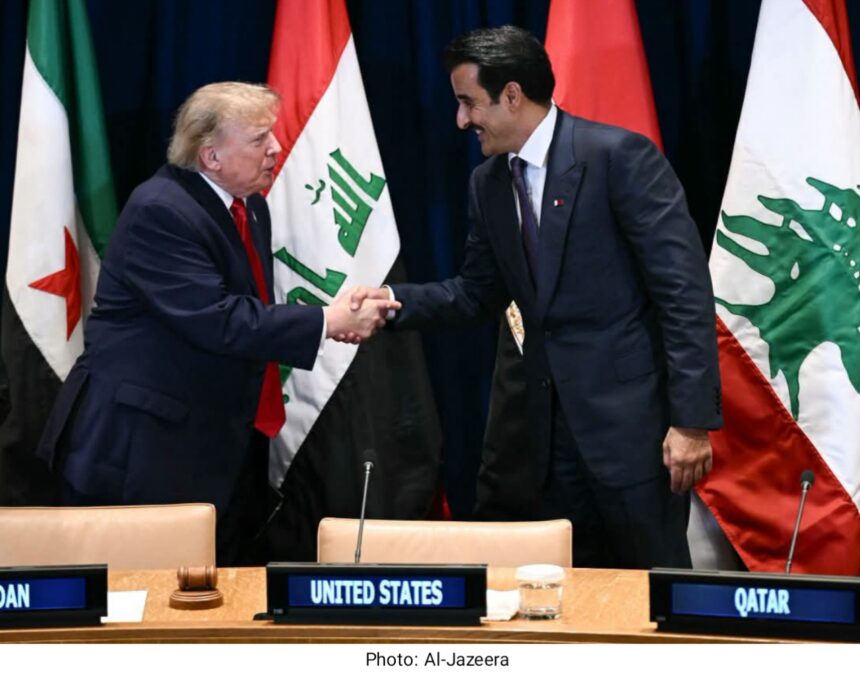
Qatar has emerged as an important mediator in the diplomatic efforts. Qatari Emir Sheikh Tamim bin Hamad Al Thani, speaking at the UN General Assembly, described the Gulf region as being in an extremely dangerous phase and called for diplomacy. He warned that years of diplomatic failures and delays had contributed to the worsening situation.
Qatar’s role as a mediator is not new. The Gulf state has previously helped facilitate indirect contacts between Washington and Tehran. In the current crisis, Qatar is attempting to maintain a channel through which the United States and Iran can discuss key issues without allowing the conflict to escalate further.
There have also been diplomatic signals from Tehran. According to Al Jazeera’s reporting from Tehran, Iranian Foreign Minister Abbas Araghchi met US special envoy Steve Witkoff on the sidelines of the UN General Assembly. Iranian state media reported that the meeting took place at Witkoff’s request. Araghchi later said Iran remained committed to diplomacy aimed at achieving calm and security. He also argued that previous US violations of commitments remained a major obstacle to diplomatic efforts.
At the same time, there are signs of differing views inside Iran over negotiations. Al Jazeera reported that a spokesman for Iran’s Islamic Revolutionary Guard Corps took a tougher position on negotiations and said Iran should remain prepared for all possible scenarios. This indicates that while diplomatic contacts are taking place, different parts of Iran’s security and political establishment are not necessarily sending identical messages.
The United States has also been sending mixed signals. On one hand, Trump described the meeting as “very good” and productive and indicated that further talks could take place. On the other hand, his UN address included strong military warnings toward Iran. As a result, diplomacy and military pressure are continuing simultaneously.
This contrast is one of the defining features of the current situation. If the talks move toward a ceasefire or a broader agreement, shipping through the Strait of Hormuz, global oil supplies and regional security could improve. If the talks fail, however, military tensions could rise again. For that reason, governments and international observers are closely following every meeting in New York and every public statement from Washington and Tehran.
The situation in Yemen is also closely linked to the wider US-Iran confrontation. Saudi Arabia and other Gulf states are concerned about protecting their security and energy infrastructure. Reuters has reported growing concerns over Saudi oil facilities and regional security. At the same time, the need to maintain safe and unrestricted navigation through both the Strait of Hormuz and the Bab el-Mandeb has become an important international issue.
Russia and Saudi Arabia have also expressed concern over maritime security. Reuters reported that Russian President Vladimir Putin and Saudi Crown Prince Mohammed bin Salman discussed the importance of safe and unrestricted navigation through the Strait of Hormuz and the Bab el-Mandeb during a phone call. They also discussed the military and political situation in Yemen and the need for diplomatic efforts.
The economic impact of the conflict is also becoming increasingly visible. Uncertainty over energy supplies from the Middle East has contributed to significant movements in global oil markets. In an Al Jazeera update on September 23, Brent crude was trading near $99 a barrel while West Texas Intermediate was around $90. The restoration of alternative Saudi supply routes and growing hopes for diplomatic progress at the UN were cited among the factors affecting the market.
At the same time, the United States is continuing to increase economic pressure on Iran. Al Jazeera reported that Washington had taken new measures targeting Iranian airlines and putting pressure on international aviation links involving Iran. The effects of the conflict are therefore extending beyond the battlefield into transportation, trade and the wider economy.
The Middle East crisis has also featured prominently in speeches by world leaders at the UN General Assembly. Qatar’s emir has called for an end to the war through diplomacy, while leaders from several countries have stressed the need to protect civilians and respect international law. The situation in Palestine has also remained a major issue during the gathering. As a result, New York has become a major center for discussions on the US-Iran conflict, Gaza, the Israeli-Palestinian issue and wider international security.
Several major questions remain at the center of the US-Iran discussions. The first is what conditions the two sides could accept for ending the war. The second concerns how commercial shipping through the Strait of Hormuz could be restored. The third is what arrangements could be reached over Iran’s nuclear programme. The fourth is whether the United States would ease sanctions or other economic restrictions. The fifth is whether tensions can be reduced simultaneously across the other regional fronts connected to the conflict.
The biggest uncertainty is that major differences remain between the public positions of Washington and Tehran. The United States has focused on limiting Iran’s nuclear capabilities while maintaining economic and military pressure. Tehran, meanwhile, has placed the end of the war, a reduction in military pressure, the lifting of blockades and restrictions, and the release of Iranian assets among its key demands.
Nevertheless, the renewed diplomatic contacts at the United Nations represent another stage in efforts to reduce tensions. Reuters has reported that Iran has indicated it could consider reopening the Strait of Hormuz, but has linked such a step to a reduction in US military pressure and the lifting of restrictions. This means the Strait of Hormuz is not simply part of the military crisis; it could also become an important element in any future agreement.
The central question now is whether the contacts in New York will lead to a concrete agreement. Trump has described the meeting positively, but no detailed agreement has been announced. Iran has also kept the door to diplomacy open while clearly outlining several conditions. At the same time, military tensions and the wider regional conflict continue.
As of September 23, 2026, the developments can therefore be seen as a potentially important diplomatic moment, but there is not yet enough information to describe them as a final breakthrough or settlement. Further meetings, negotiating conditions and the next steps taken by both sides will determine whether the current contacts move toward a ceasefire and broader political agreement or whether military tensions intensify again.
For now, diplomatic activity in New York and the situation around the Strait of Hormuz remain two of the main areas of international attention.
Sources: Al Jazeera, Reuters,