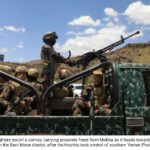
Tensions across the Middle East are intensifying on multiple fronts, with Israeli military operations in southern Lebanon, renewed Saudi-Houthi confrontation around Yemen, mounting US economic pressure on Iran and Qatar’s diplomatic engagement with Tehran creating a complex mix of military escalation and regional diplomacy. Recent international reports have documented continued Israeli military activity in southern Lebanon, where Lebanese authorities have accused Israel of carrying out attacks and causing extensive damage to forests and farmland. Lebanon’s Prime Minister Nawaf Salam has condemned Israeli strikes in the south as violations of international law, while Israel has argued that some of the targeted areas were being used for military purposes. However, the specific claim circulating online that Israel completely destroyed a 150-year-old village in southern Lebanon using cluster bombs has not been independently confirmed by major international news organisations and should therefore be treated with caution rather than presented as an established fact. The situation is unfolding alongside renewed tensions between Saudi Arabia and Yemen’s Houthi movement. International conflict-monitoring reports indicate that Houthi attacks and Saudi military responses have increased, raising concerns that the Yemen conflict could once again develop into a broader confrontation. Reports have also suggested that Saudi forces have been preparing for possible military operations against the Houthis, although it remains unclear whether Riyadh intends to launch a full-scale offensive or is seeking to strengthen deterrence and protect its territory and regional interests. At the same time, Saudi Arabia has been dealing with severe weather conditions, including heavy rainfall and the risk of flash flooding in areas including Taif and parts of the Mecca region. Saudi authorities have issued weather warnings and urged residents to avoid valleys and areas vulnerable to sudden water flows. The combination of extreme weather and heightened regional security concerns has added further pressure on the kingdom. The most significant strategic confrontation, however, remains the growing economic and political pressure between Washington and Tehran. The administration of US President Donald Trump has intensified efforts to restrict Iran’s access to international trade and financial networks, while warning countries and companies that continue significant economic dealings with Tehran that they could face secondary sanctions. Reuters reported on August 27 that Trump said the United States was not currently negotiating with Iran and that Washington was focusing instead on economic pressure. Iran, meanwhile, has continued to reject Washington’s demands and has sought to maintain commercial and financial relationships through alternative channels and regional partners. Rather than simply “ignoring” US sanctions, Iran is facing significant economic pressure while attempting to withstand it without conceding to Washington’s political demands. The dispute has increasingly involved third countries as Washington seeks to persuade or pressure Iran’s trading partners to reduce their economic ties with Tehran. Reports circulating about the US contacting 15 Middle Eastern countries and receiving eight outright rejections, with seven others refusing to give a clear answer, have not been independently confirmed in that precise form by major international news agencies and should therefore not be presented as established fact. Qatar, meanwhile, has emerged as one of the region’s most important diplomatic channels. Qatar’s Prime Minister and Foreign Minister Sheikh Mohammed bin Abdulrahman Al Thani travelled to Tehran on August 27 as Doha sought to reduce tensions and facilitate communication over the wider US-Iran confrontation. Reuters reported that Qatar was pursuing mediation efforts aimed at reducing tensions and addressing the situation surrounding the Strait of Hormuz, one of the world’s most strategically important energy routes. The Qatari initiative highlights the increasingly important role of Gulf states attempting to balance their security relationships with Washington while maintaining working diplomatic and economic ties with Tehran. Iran has also issued increasingly forceful warnings about any new US military action. Iranian official Mohsen Rezaei has warned that a fresh American attack would trigger a response on an “earthquake-like” scale. The phrase is best understood as political and military rhetoric describing a severe retaliation rather than a literal reference to a physical earthquake. His remarks reflect Tehran’s broader effort to deter Washington from opening another major military front while signalling that Iran would respond forcefully to any renewed attack. The current crisis therefore extends far beyond the direct confrontation between the United States and Iran. Southern Lebanon remains a major flashpoint, Yemen is again at risk of becoming a wider regional battlefield, Saudi Arabia is confronting both security and extreme-weather challenges, while Qatar and other regional actors are attempting to keep diplomatic channels open. At the same time, the economic confrontation surrounding Iran is becoming increasingly internationalised as Washington seeks to restrict Tehran’s ability to trade and generate revenue while Iran works to preserve its economic links with neighbouring and non-Western partners. The Strait of Hormuz remains particularly important in this equation because any prolonged disruption could affect global energy supplies, shipping costs and international oil markets. The coming days are therefore likely to be crucial. A further escalation involving Iran, Israel, the United States or regional armed groups could rapidly widen the conflict, while successful mediation by Qatar or other regional actors could create an opening for renewed diplomacy. For now, the Middle East remains caught between two competing trajectories: a wider regional war driven by military escalation, and a fragile diplomatic effort aimed at preventing the conflict from spreading further.
The heat of war in the Middle East is increasing: Israeli attacks in Lebanon, Saudi preparations in Yemen