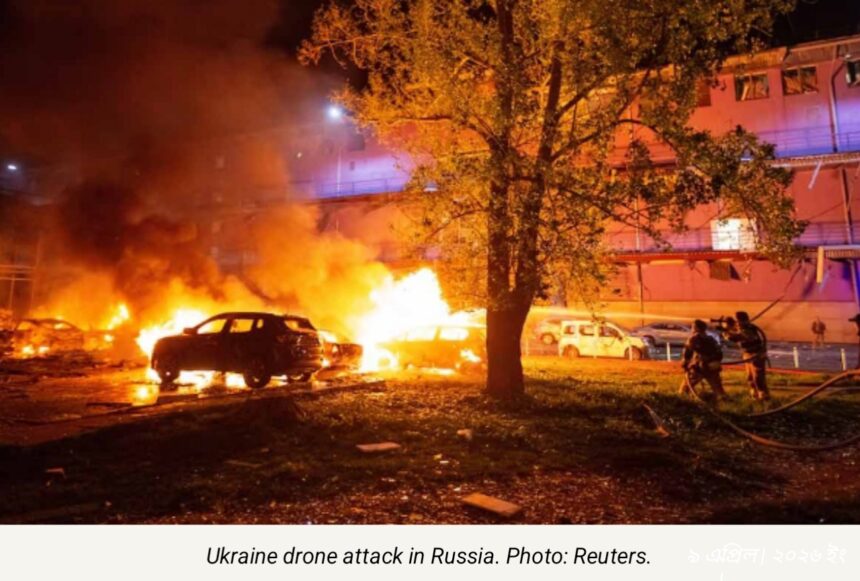
Ukraine has released new details about one of its deepest long-range drone operations of the war, confirming that its Special Operations Forces (SOF) carried out a coordinated strike against Russia’s major petrochemical and energy hub in Nizhnekamsk, located in the Republic of Tatarstan, roughly 1,100–1,200 kilometers from the Ukrainian border. According to Ukrainian officials, the overnight operation on 8 July 2026 employed long-range kamikaze drones that successfully penetrated Russian air defense systems before striking several strategically important industrial facilities that play a critical role in Russia’s fuel production and petrochemical sector. Among the primary targets was the TANECO Oil Refinery, operated by Tatneft, one of Russia’s largest and most technologically advanced refineries with an annual processing capacity of approximately 16 million tonnes, producing gasoline, Euro-5 diesel, and aviation fuel. Ukrainian sources also identified the TAIF-NK Oil Refinery as another key target, with videos circulating on social media reportedly showing a drone impacting the facility moments before a powerful explosion. In addition, the operation targeted Nizhnekamskneftekhim (NKNH), one of Eastern Europe’s largest petrochemical complexes, where multiple fires and significant damage were reported across the industrial zone. Images and videos emerging from the area showed thick black smoke rising above the sprawling industrial complex as emergency services responded to multiple fire outbreaks. Russian authorities acknowledged that several industrial facilities sustained damage during the attack and confirmed that a number of people suffered minor injuries. Nizhnekamsk Mayor Radmir Belyaev warned residents that the large-scale drone assault was still underway and urged the public to remain vigilant while emergency responders worked to contain the situation. As a precautionary security measure, Russian aviation authorities temporarily suspended flight operations at Kazan, Nizhnekamsk, and Bugulma airports to reduce potential risks posed by the ongoing drone threat. Meanwhile, Russia’s Ministry of Defense claimed its air defense systems intercepted a total of 415 Ukrainian drones across the country during the overnight assault, describing it as one of the largest drone attacks in recent months. Despite those interception claims, reports indicated that several drones reached their intended targets, with additional strikes reported in multiple regions, including the Saratov Oil Refinery, where local sources said one person was killed. The operation underscores Ukraine’s expanding capability to conduct precision long-range strikes deep inside Russian territory, targeting critical energy infrastructure that supports both the Russian economy and military logistics. Military analysts note that repeated attacks on refineries, petrochemical plants, and fuel storage facilities are intended to disrupt fuel production, complicate military supply chains, and increase the economic costs of the conflict. The latest strikes are expected to further intensify tensions between Moscow and Kyiv as both sides continue to expand the scale and reach of their long-range aerial operations, highlighting the increasingly strategic role of drone warfare in the evolving conflict.
Ukraine’s coordinated drone attack on Russian industrial zone 1,200 kilometers away