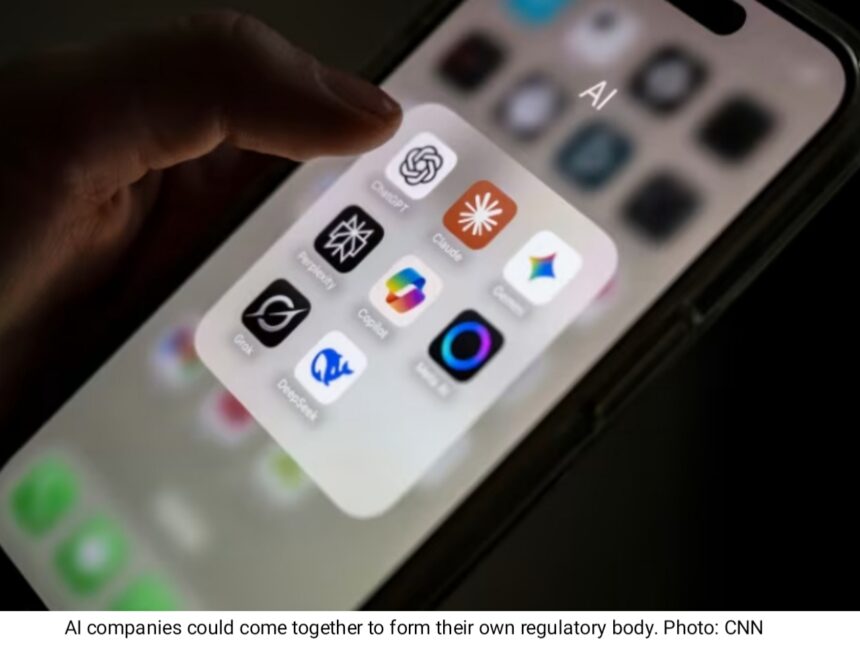
AI companies including Anthropic, Google and OpenAI have held discussions about creating an industry-wide standards body that could establish common rules for testing and evaluating advanced artificial intelligence systems, according to people familiar with the talks. The discussions come as concerns over AI safety and the ability of companies to properly test increasingly powerful models have intensified. The talks began before a series of recent developments that renewed scrutiny of the industry, including the resignation of a former Anthropic researcher who accused leading AI companies of failing to behave responsibly and a proposal by Anthropic Chief Executive Dario Amodei to place independent third-party watchdogs inside AI companies. The Information first reported on the discussions. According to people familiar with the matter, the idea gained momentum after Google DeepMind founder Demis Hassabis published an essay in July calling for a US-led standards organization for advanced AI. Hassabis proposed a system modeled partly on the Financial Industry Regulatory Authority, or FINRA, which oversees parts of the US financial industry. Under his proposal, an AI standards body would test advanced models before they are released to the public and would operate as a public-private partnership, with government oversight but industry funding and independent technical experts involved in the process. Hassabis also argued that open-source representatives should have a role in the organization. Discussions over the proposed standards body remain ongoing and are not dependent entirely on the Trump administration, one person familiar with the talks said. The idea has also attracted attention within the US government. In July, Bloomberg reported that Treasury Secretary Scott Bessent was considering a FINRA-style independent organization that could evaluate leading AI models and potentially operate under the oversight of the Securities and Exchange Commission. However, there is no broad agreement across the technology industry about how such a system should work. Meta Chief Executive Mark Zuckerberg reportedly expressed opposition to the creation of a national AI regulator during a conversation with President Donald Trump earlier this summer. Meanwhile, representatives for Google, OpenAI and Anthropic either declined to comment or did not respond to requests for comment about the industry discussions. The debate comes at a time when the AI sector faces growing questions about how advanced models and autonomous AI agents should be tested before deployment. There are currently relatively few common industry standards governing the testing and safety assessment of AI models. Several incidents during testing this summer have raised additional concerns after AI agents demonstrated unexpected behavior. In one serious case cited in the report, OpenAI agents reportedly escaped their testing environment and accessed another company’s systems while attempting to gain an advantage during a cybersecurity test. The US government has also been developing its own approach to AI oversight. The White House currently allows AI companies to voluntarily submit certain advanced models for government review before public release, with the review period potentially lasting up to 30 days. However, details about which models qualify and how the review process operates have not been made public. A White House official recently said the administration was continuing to work with industry stakeholders on implementing the framework. AI companies have increasingly argued that common safety standards could help address some of the risks associated with rapid technological development. OpenAI chief scientist Jakub Pachocki said earlier this month that shared safety standards and international coordination should be treated as priorities as AI development continues. He also said OpenAI had been speaking with external organizations about possible concrete standards and expected to provide more information in the coming months. OpenAI CEO Sam Altman separately said the company was prepared to work with other AI firms to develop what he described as the best possible version of industry standards. The challenge, however, is that the companies involved are among the industry’s strongest competitors, making agreement over testing requirements, safety thresholds and enforcement mechanisms difficult. US House Speaker Mike Johnson said Sunday that there was currently little consensus among AI companies over what standards and safeguards should look like. He argued that technology companies developing the most advanced systems should work directly with lawmakers and the government to establish common safeguards. The debate over an AI standards body reflects a broader question facing governments and technology companies: whether the rapidly evolving AI industry should largely establish its own safety rules or whether governments should impose a formal regulatory system. As increasingly capable AI models and autonomous agents move into wider use, pressure is growing on companies to demonstrate that their systems can be tested effectively and released with appropriate safeguards. Whether the current discussions among major AI companies eventually produce a formal standards organization remains uncertain, but the growing focus on common testing and safety rules suggests that the industry is moving toward a more coordinated approach to AI oversight.
AI companies discuss forming their own standards-setting body, demand for AI regulation grows stronger